


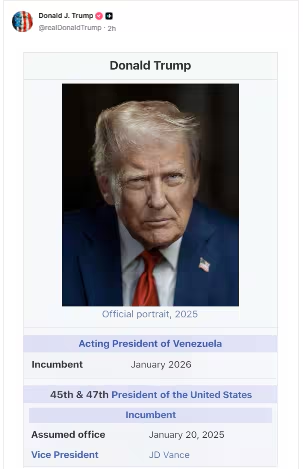
Former U.S. President Donald Trump sparked global debate after sharing a digitally altered image on Truth Social in which he is labeled as the “Acting President of Venezuela.” The post surfaced days after the dramatic arrest of Venezuelan leader Nicolás Maduro and his wife, Cilia Flores, during a U.S.-led operation.
The image, styled to resemble a Wikipedia page and featuring Trump’s official portrait, included the caption “Acting President of Venezuela” beneath his name. The post quickly went viral, drawing criticism and confusion worldwide, as there is no legal or constitutional basis for a U.S. political figure to assume executive authority over Venezuela.
Venezuela’s Constitutional Succession Explained
Contrary to Trump’s social media claim, Venezuela’s leadership transition followed its own constitutional framework. The country’s Supreme Tribunal of Justice formally appointed Vice President Delcy Rodríguez as acting president to ensure continuity of governance after Maduro’s removal. This process was entirely domestic and not influenced or directed by the United States.
International legal experts have emphasized that Venezuela remains a sovereign nation, and no foreign leader can claim its presidency through declaration or symbolism.
Trump’s Statements Fuel Diplomatic Tensions
Following Maduro’s capture, Trump made several controversial remarks during public appearances, suggesting that the United States would “run” Venezuela temporarily to stabilize the country and “get the oil flowing.” In another statement, he claimed the U.S. was now “in charge” of Venezuela, comments that intensified diplomatic tensions across Latin America.
However, U.S. officials later attempted to distance the administration from those remarks. Secretary of State Marco Rubio clarified that while Washington would continue economic pressure — including restrictions on Venezuelan oil exports — the U.S. does not intend to directly govern the country.
Trump Also Jokes About Cuba Leadership
Adding to the controversy, Trump reshared another post jokingly suggesting that Marco Rubio should become president of Cuba, captioning it with “Sounds good to me.” Observers widely interpreted the remark as satire, though critics argue such posts blur the line between humor and foreign policy rhetoric.
Growing Global Reaction
Maduro has pleaded not guilty in U.S. court and continues to challenge his detention, claiming violations of international law and sovereign immunity. Meanwhile, Trump’s altered image post has drawn sharp reactions from political analysts, who warn that viral political content can mislead the public during already volatile geopolitical situations.
As events continue to unfold, global attention remains fixed on Venezuela, where constitutional authority, international law, and foreign influence are colliding at a critical moment.


